
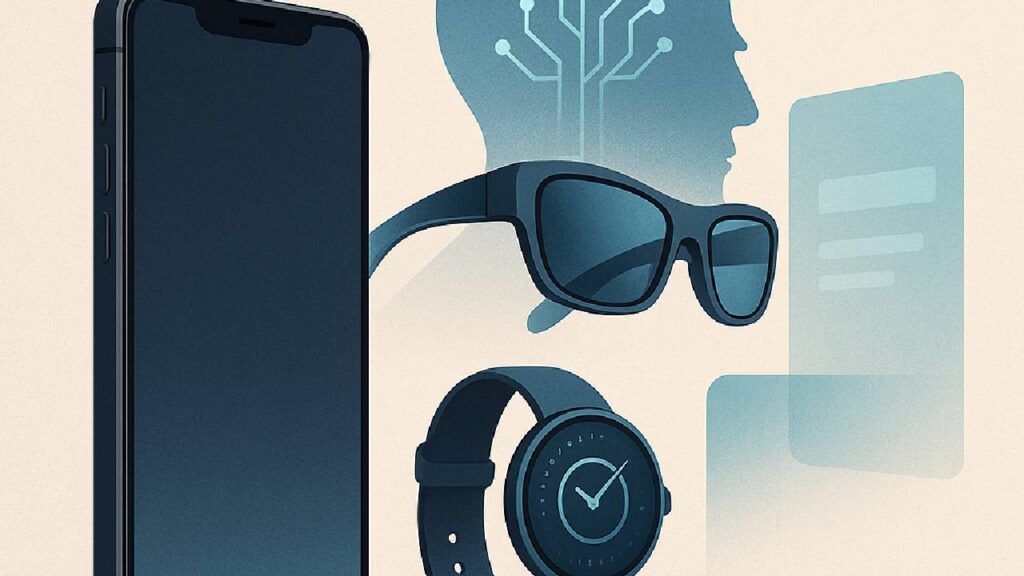
The Quiet Shift Away From Smartphones Has Already Begun
For more than a decade, the smartphone has shaped modern life, from how we work to how we communicate. Yet in the background, a subtle change is underway. Innovation in phones has slowed, upgrade cycles have stretched, and the excitement that once surrounded new launches has faded.
This shift is opening space for something bigger. As Tech Giants Envision Future Beyond Smartphones, they’re laying the foundation for a world where digital experiences blend more seamlessly with everyday living — not through a single device, but through an ecosystem of smarter, more intuitive tools.
The Smartphone Era Has Reached Its Plateau
The conversation about “what comes next” is no longer speculative. Industry data shows a consistent drop in global smartphone shipments, along with longer replacement cycles. People are keeping their phones an average of three to four years now, partly because new models introduce only marginal improvements.
A Market Nearing Its Limits
This slowdown doesn’t mean phones are disappearing tomorrow. But it does point to a maturing market where breakthrough ideas grow harder to deliver. That plateau is nudging companies like Apple, Google, Samsung, and Meta to rethink what personal technology could look like when the dominance of the smartphone fades.
Recent industry estimates show smartphone shipments slipping from 1.39 billion units in 2021 to about 1.18 billion in 2024. The trend is steady, not sudden — the kind of gradual shift that often precedes major technological transitions.
AR and Mixed Reality Devices Are Moving From Novelty to Strategy
Augmented and mixed-reality devices are no longer treated as experiments. They now sit at the center of long-term roadmaps for major tech companies.
AR glasses, in particular, signal an ambition to reshape how people interact with digital information — not through screens, but through layers of content positioned directly in our field of view.
A New Interface for Everyday Tasks
Apple’s Vision Pro and Meta’s Quest lineup have sparked renewed interest in spatial interaction. Early versions are still bulky and expensive, but the direction is clear: a future where directions appear as overlays on real streets, messages float subtly into view, and workspaces become portable 3D environments.
These devices offer potential in areas such as:
- Navigation without lifting a phone
- Hands-free messaging or video calls
- Immersive productivity, entertainment, and collaboration
- Real-time contextual information in physical spaces
What once sounded futuristic is slowly becoming practical.
AI Assistants Are Evolving Into the Interface That Replaces Apps
The rise of stronger AI systems may be the most defining factor shaping life after smartphones. Instead of tapping through apps, people will rely on conversational, highly personalized AI that understands routines and anticipates needs.
From Tool to Companion
The next generation of AI assistants — from Google’s improved Assistant to OpenAI’s conversational systems — aims to reduce friction in daily tasks:
- Scheduling without opening a calendar
- Managing home devices through voice
- Handling complex digital chores such as summarizing documents or drafting messages
- Providing real-time insights based on context
As AI becomes more capable, it shifts the center of digital life away from apps and screens and toward what experts call ambient intelligence — technology that works quietly, often without a direct command.
Wearables Are Becoming the New Daily Essential
Wearables have evolved far beyond step counters. Today’s smartwatches, rings, and health sensors are quietly taking over responsibilities once reserved for smartphones.
A Health and Communication Hub on Your Wrist
Companies like Apple, Samsung, and Huawei are pushing wearables into the territory of medical-grade monitoring. Features such as heart rhythm tracking, sleep mapping, stress detection, and workout optimization are now standard.
Tomorrow’s wearables may offer:
- Continuous health screening
- Gesture-based controls
- Messaging and calling without a phone
- Direct integration with AI assistants
Wearable shipments have risen from roughly 533 million units in 2021 to more than 700 million in 2024 — a sign that people are warming to a future where the wrist becomes the new command center.
Spatial Computing Brings Digital Content Into Real Space
Spatial computing takes AR a step further by turning physical rooms into interactive environments. It allows people to work with data, tools, and apps as if they were part of the room itself.
A New Way to Work and Create
Devices like Microsoft’s HoloLens have already proven valuable in design, training, engineering, and medical fields. The next wave aims to bring these capabilities to regular homes and offices.
Imagine a world where:
- Your workspace floats in mid-air
- Large screens appear when needed, then vanish
- Collaboration happens in 3D, not video grids
- Design tools respond to natural gestures
It’s a shift that feels more intuitive than tapping and swiping.
The Metaverse Still Matters — Just Not How It Was First Imagined
While early hype around the metaverse cooled, the underlying concept lives on in more grounded forms: digital twins for factories, enterprise collaboration, 3D commerce, and virtual social spaces.
A More Practical Metaverse
Companies like Meta and Nvidia now focus less on cartoon avatars and more on practical use cases. In this version of the metaverse, virtual environments help businesses operate more efficiently and give people new ways to work or socialize — but without replacing the real world.
Challenges That Still Stand in the Way
Even as Tech Giants Envision Future Beyond Smartphones, several hurdles need solving before this new era arrives.
What’s Holding the Future Back
- Devices are still costly for the average consumer
- Battery life limits functionality
- Privacy concerns grow as sensors become more sensitive
- Social acceptance takes time — people need to feel comfortable wearing new devices
Transitions in technology often happen slowly, then all at once. For now, we are in the slow phase.
Why This Shift Matters
Moving beyond smartphones isn’t just about new gadgets. It’s about reshaping the way people live, work, and connect.
A world of blended digital and physical experiences could reduce screen fatigue. AI could take over repetitive tasks. Wearables could offer deeper insights into health. And mixed reality could redefine workplaces, entertainment, and creativity.
This moment marks the early chapters of a broader story — one that may define the next decade of technology.
A Future Not Built Around a Device, but Around People
As Tech Giants Envision Future Beyond Smartphones, they’re not simply chasing the next hit product. They’re designing systems that fade into the background and serve people with greater ease and intelligence.
The smartphone won’t vanish anytime soon. But the center of innovation is already shifting toward tools that feel more natural, more immersive, and far more personal.
The next era of digital life won’t be defined by holding a device — but by how effortlessly technology fits into the rhythm of daily living.