
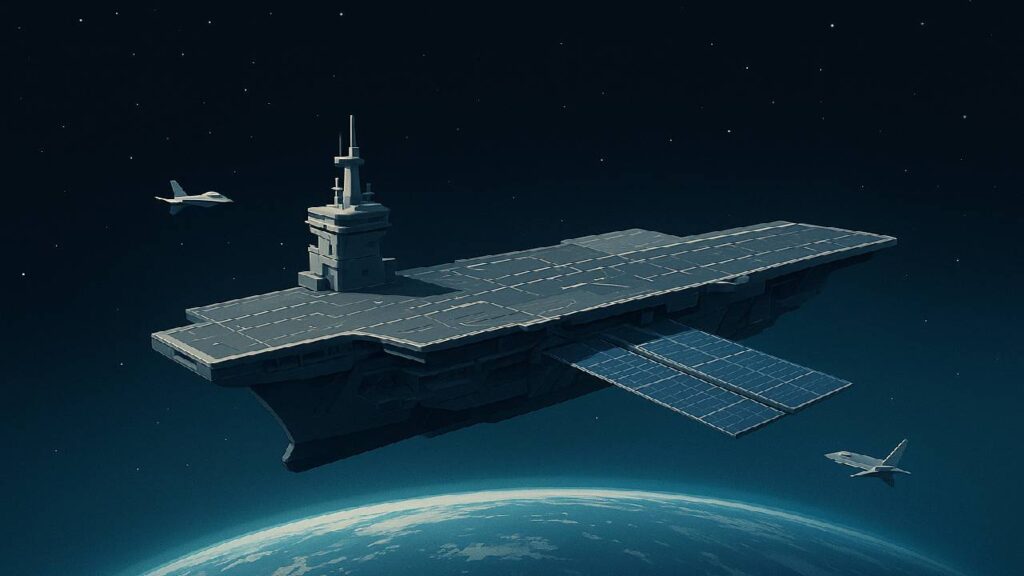
The Space Force Orbital Aircraft Carrier Ushers in a New Era of Defense
A generation ago, the idea of an aircraft carrier floating in space would’ve sounded like science fiction. Today, it’s edging toward reality. The Space Force Orbital Aircraft Carrier, still in conceptual development, could one day orbit Earth as a mobile command base—launching drones, defending satellites, and serving as a bridge between military readiness and the frontier of space.
In a world increasingly dependent on satellites for communication, navigation, and surveillance, the ability to protect orbital assets isn’t just strategic—it’s essential. The carrier’s development represents the next phase of national defense, one where security extends far beyond the atmosphere.
A Vision Born from the U.S. Space Force’s Mandate
The U.S. Space Force, founded in 2019, was built on a clear idea: the next battlefield may not be on land or sea, but in orbit. The creation of the Space Force Orbital Aircraft Carrier stems from that mission—to protect and maintain dominance in the rapidly evolving domain of space.
From Science Fiction to Strategic Reality
The notion of a floating military base in orbit has long fascinated scientists and storytellers alike. But advances in reusable launch systems, modular spacecraft design, and lightweight composites have pushed the idea closer to feasibility.
Organizations like DARPA, NASA, and SpaceX have laid the groundwork, developing propulsion and assembly technologies that could one day make large-scale orbital structures viable.
Engineering the Impossible
Behind the bold idea lies a feat of engineering that challenges what’s physically possible in space.
Design and Core Systems
The proposed orbital carrier would be built from modular components—each launched separately and assembled in low Earth orbit. Key sections include:
- Command Deck: The brain of the vessel, managing communication and navigation.
- Hangar Bay: A storage and deployment hub for drones and small spacecraft.
- Solar Array: Harnessing sunlight for sustainable energy.
- Defense Grid: Protecting the carrier from debris and external threats.
Engineers envision using graphene-infused alloys and radiation shielding to handle the extreme conditions of space.
Propulsion and Power
To remain operational, the carrier would rely on nuclear-electric propulsion combined with ion thrusters—technologies designed for long-term stability with minimal fuel use. Power would come primarily from high-efficiency solar panels capable of producing over a megawatt of energy.
Automation and AI Integration
Artificial intelligence would oversee daily operations, from drone deployment to predictive maintenance. The ship’s autonomous systems could detect threats and coordinate responses within seconds, far faster than any human crew could manage.
| Feature | Description | Example Technology |
|---|---|---|
| Propulsion | Ion/Nuclear Hybrid | NASA NEXT-C |
| Energy Source | Solar Array | 1.5 MW Capacity |
| Defense Drones | Autonomous | “Sentinel” Class Prototypes |
Why It Matters: Strategic Advantage in Orbit
The Space Force Orbital Aircraft Carrier could redefine how nations approach security in the 21st century.
Expanding Defense Beyond Earth
Modern warfare depends on space-based infrastructure—GPS, surveillance satellites, communication networks. A single orbital platform capable of launching drones or repairing satellites gives the U.S. a unique strategic advantage.
This carrier wouldn’t just monitor threats; it could respond instantly, intercepting missiles or neutralizing hostile satellites before they reach critical systems.
A Global Ripple Effect
The introduction of such a defense platform would likely reshape international dynamics. Countries including China and Russia have already accelerated their space defense programs, signaling that orbital security is becoming the next frontier in geopolitics.
While the Outer Space Treaty of 1967 prohibits weapons of mass destruction in orbit, it leaves room for interpretation regarding defensive technologies—creating a gray area that nations are beginning to explore.
Operational Potential: Beyond Defense
Though designed for security, the orbital carrier’s potential extends to science, communication, and exploration.
Launch, Repair, and Recovery
Robotic docking arms and magnetic launch systems could deploy micro-satellites and drones with precision. The same systems could retrieve or repair damaged satellites—an operation that today requires costly missions.
A Living Laboratory in Orbit
Beyond defense, the carrier could serve as a platform for space research and development. It could support deep-space missions or test new propulsion systems before they’re deployed on interplanetary journeys.
Such dual-use capability—military precision combined with scientific versatility—could make the orbital carrier one of the most valuable assets ever placed in orbit.
Challenges and the Ethics of Space Militarization
Every leap in technology comes with questions about responsibility.
Engineering and Cost Barriers
Assembling a structure of this scale would require unprecedented cooperation between the military, private industry, and international partners. The costs would likely reach hundreds of billions of dollars, making efficiency and modular scalability essential.
Space Debris and Orbital Safety
The risk of debris collisions remains one of the most pressing challenges. Even a tiny piece of orbital junk can destroy equipment at high velocity. Any new structure must integrate collision-avoidance systems and contribute to debris mitigation, not worsen it.
Ethical Implications
Critics argue that militarizing space could accelerate a global arms race. Supporters counter that space-based defense systems act as deterrents, ensuring peace through technological superiority. The debate mirrors those of earlier eras—nuclear, cyber, and now orbital.
Looking Ahead: From Concept to Reality
While the Space Force Orbital Aircraft Carrier is still a conceptual project, its development aligns with ongoing U.S. investments in space infrastructure.
Projected Timeline
Industry analysts suggest early prototypes or simulation models could emerge within the next decade. If progress continues, partial deployment might be achievable by the 2040s.
Key partnerships—between defense agencies, private aerospace firms, and research institutions—will determine whether this vision becomes tangible.
Beyond Defense: Civil and Commercial Promise
The technologies behind the carrier could also revolutionize satellite servicing, space tourism, and orbital construction. Innovations developed for military purposes often spill over into civilian applications—GPS, the internet, and satellite imaging all began as defense projects.
In this sense, the orbital carrier isn’t just about security; it’s about expanding what humanity can build, protect, and sustain beyond Earth.
A Glimpse of Tomorrow
The Space Force Orbital Aircraft Carrier represents a shift in how humanity views space—not merely as a void to explore, but as a domain to protect and manage responsibly.
It’s an ambitious idea, perhaps decades away from full realization. Yet every major technological revolution begins as a vision just like this. The seas once marked the edge of human expansion. Then came the skies. Now, it’s the stars.
When that carrier finally glides into orbit, it won’t just be a military milestone. It will be a reminder of how far imagination—and necessity—can take us.